
The Xbox Series X/S and PlayStation 5 entered the market at roughly the same time, but their current console cycles have produced vastly different outcomes. While Sony's platform has consistently secured major third-party launches, Microsoft's Xbox brand has struggled to bring some of the biggest games to its ecosystem in a timely manner. This recurring issue has led many to wonder whether developers are deliberately avoiding Xbox. Among the most glaring examples is Black Myth: Wukong, a title that sold over 20 million units across PlayStation and PC but remained absent from Xbox for an entire year. When asked about its Xbox release, Phil Spencer, CEO of Microsoft Gaming, claimed he "knew" when it would arrive—but when pressed for a date, he simply said, "I can't say it."
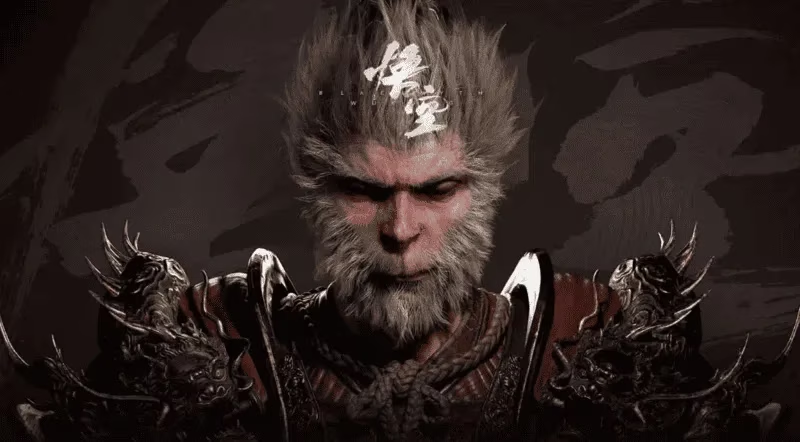
That exchange, translated from Spanish and shared on Reddit, encapsulates the frustration surrounding Xbox's software lineup. Spencer's refusal to provide a timeline could mean several things: perhaps the game was not coming in 2024, or perhaps he genuinely did not know and was merely projecting confidence. Given Microsoft's history of making optimistic statements that later unravel, skepticism is warranted. After all, this is the same executive who once insisted that key Xbox exclusives would not go multiplatform—only for several of them to appear on rival consoles later that same year. Surprise.
The Black Myth: Wukong situation is not an isolated incident. It is part of a broader pattern that has plagued Xbox throughout the Series X/S generation. Missing the launch window of a massive title is one thing, but doing so repeatedly suggests systemic problems. Consider Larian Studios, the developer behind Baldur's Gate 3, which went on to win Game of the Year. Xbox reportedly did not want to put the game on Game Pass—a decision Larian was fine with—but the platform still missed the game's initial launch. Worse, Larian was forced to make technical adjustments for both the Xbox Series X and the less powerful Series S, which led to additional delays and complications. Wukong's Xbox version was said to have similar optimization challenges, adding another black eye to Microsoft's console.

Why does this keep happening? Is it a matter of hardware limitations, business strategy, or simply poor communication? The answers remain murky, but the consequences are clear. Xbox players are left waiting while other platforms enjoy the biggest releases. In an era where exclusive content and timely access drive console sales, such delays can be devastating.
By 2026, the wait for Black Myth: Wukong on Xbox finally ended—the game arrived on Xbox Series X/S in August 2025, roughly a year after its original release. Yet the delay left a lasting mark. The conversation around Xbox's inability to secure major titles at launch has not disappeared. If anything, it has intensified as the industry looks ahead to the next generation of hardware.
A quick comparison highlights the disparity:
| Game | Original Launch Platforms | Xbox Arrival | Key Issue |
|---|---|---|---|
| Black Myth: Wukong | PS5, PC (Aug 2024) | Xbox Series X/S (Aug 2025) | Delayed optimization, unclear timeline |
| Baldur's Gate 3 | PC, PS5 (2023) | Xbox Series X/S (Dec 2023) | Series S split-screen constraints |
| Other major titles | Various | Often delayed or skipped | Game Pass strategy, parity clauses |
This table tells a story of missed opportunities. Each delay erodes trust among Xbox fans and makes the platform less attractive to newcomers. Microsoft has tried to counter this narrative with acquisitions and Game Pass deals, but the core problem remains: the biggest games do not always show up on Xbox when they matter most.
Phil Spencer's "I can't say it" moment may seem minor in isolation, but it symbolizes a larger communication gap. When a platform holder cannot or will not give a straight answer about a highly anticipated game, it signals uncertainty. And uncertainty is the last thing Xbox needs as it fights for relevance in a crowded market.
Can Microsoft turn things around? The company has deep pockets and a growing portfolio of studios. But money alone does not solve timing issues, technical parity requirements, or strained relationships with third-party developers. The Xbox Series X/S generation is winding down, and the next Xbox is already rumored. If Microsoft wants to avoid repeating history, it must address the root causes of these delays—not just offer vague assurances.
For now, Black Myth: Wukong serves as a cautionary tale. It was a massive success everywhere but Xbox, at least initially. The game eventually arrived, but the damage to Xbox's reputation was already done. In 2026, the question is no longer whether Wukong came to Xbox, but whether Microsoft has learned anything from the experience. 🎮
As detailed in Eurogamer, platform delays often reflect a mix of technical certification hurdles, hardware-specific optimization demands, and publisher scheduling priorities rather than a single simple cause, which helps explain why high-profile releases like Black Myth: Wukong can miss Xbox at launch even when demand from players is clearly present.