
As a gamer who has been chasing 'next-gen' moments since the days of pixelated sprites, I have to say that Unreal Engine 5 is the real deal. You know that feeling when you watch a trailer and your brain short-circuits because you can't tell if it's gameplay or a pre-rendered cutscene? That's UE5 in a nutshell. Epic's latest engine has been at the forefront of gaming tech for years, and in 2026, it is still the engine to beat. From the Lumen lighting system to Nanite rendering to easier implementation of photogrammetry, UE5 has no shortage of impressive features. But let's be honest: what matters most to us gamers is how developers use these tools to create never-before-seen experiences. And one game that knocked it out of the park is Senua's Saga: Hellblade 2.
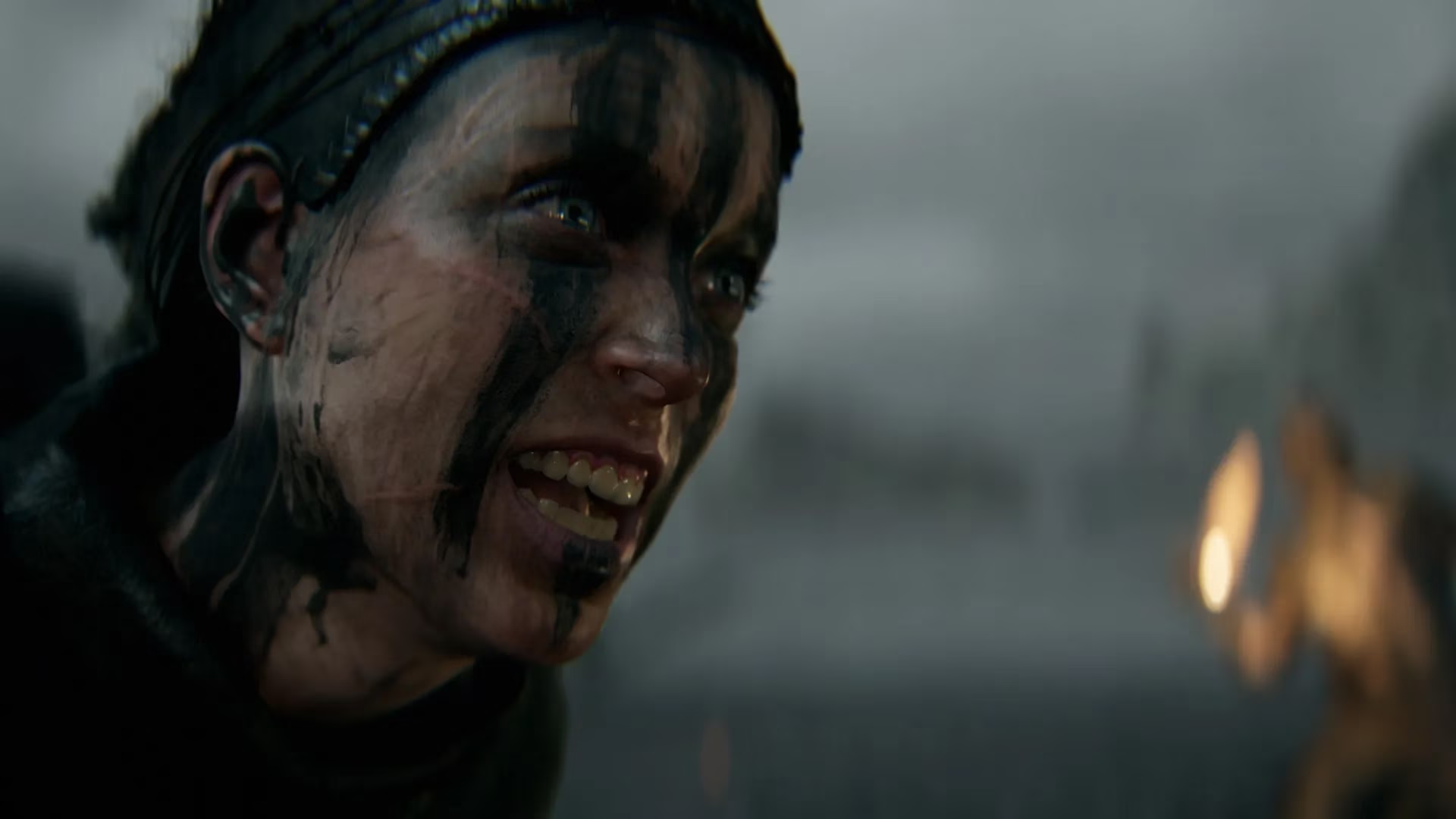
Now, before I dive into why Hellblade 2 is a visual masterpiece, let me break down the engine features that make it possible. UE5 is like a finely tuned V8 under the hood of your favorite ride—everything else depends on it.
Why UE5 Is a Game-Changer
Here's a quick rundown of the tech that keeps me up at night:
| Feature | What It Does | Why It Matters |
|---|---|---|
| Lumen | Dynamic global illumination and reflections | Lighting reacts realistically to changes, no baked shortcuts |
| Nanite | Virtualized geometry with millions of polygons | Insane detail without level-of-detail pop-in |
| Photogrammetry | Scans real-world objects and environments | Grounded, authentic visuals |
| MetaHuman | High-fidelity facial rigging and animation | Characters emote like real people |
These features are not just buzzwords. When a team like Ninja Theory grabs hold of them, the results can be staggering.
Hellblade 2: A Visual Powerhouse
Developer Ninja Theory delivered one of the best single-player experiences of recent memory with 2017's Hellblade: Senua's Sacrifice, which masterfully tells the tale of Senua, a warrior struggling with psychosis. Its follow-up, Senua's Saga: Hellblade 2, is showing that same promise—except now Senua looks much more prepared to face the larger-than-life threats in her way. I've played it on Xbox Series X and PC, and let me tell you, the game still makes my jaw drop in 2026.
What impressed me most is how Ninja Theory uses UE5's feature set without letting the tech overpower the storytelling. The latest trailers and gameplay highlight some great utilization of Epic's latest technology: impressive cloth physics, spot-on facial capture, volumetric lighting, photogrammetry, and so much more. The dark and dreary art style is the driving factor for this impressive visual presentation, but having a strong engine to work with definitely eases things up.
To be fair, the game runs at a cinematic 30 FPS on consoles, which raised some eyebrows when it first launched. But in my book, that was a smart trade-off. Senua's Saga: Hellblade 2 feels like a moody, atmospheric film more than a twitchy action game. The slower pacing lets you soak in every bead of sweat, every strand of hair, and every flicker of torchlight. It's not about pushing frames; it's about pulling you into Senua's fractured mind.
Why It Still Matters in 2026
Since Hellblade 2 launched, UE5 has powered a wave of impressive titles across the industry. I've seen everything from sprawling open-world RPGs to tight indie horrors flex the engine's muscles. But Hellblade 2 remains a benchmark because it shows what happens when art direction and technology are perfectly in sync. Ninja Theory didn't just chase realism for its own sake; they used photogrammetry to ground Senua's world in a gritty, tactile reality, and they leaned on volumetric lighting to sell the oppressive atmosphere.
The facial capture, in particular, is a masterclass. Senua's expressions are so raw and nuanced that I sometimes forgot I was looking at a digital character. For a story centered on psychosis and inner turmoil, that level of emotional fidelity is not just a nice-to-have—it's essential. It's the difference between watching a character and feeling her struggle.
At the end of the day, Senua's Saga: Hellblade 2 is currently available on Xbox Series consoles, PC, and PlayStation 5, so there's no excuse to miss it. If you want to see what Unreal Engine 5 can truly do when placed in the hands of a visionary team, this is the game that should be at the top of your list. It's not just a tech demo; it's a harrowing journey that proves UE5 is the engine driving gaming's future in 2026 and beyond.