
I never thought I would be able to walk the foggy streets of Silent Hill again and feel the same bone-deep dread that the 2001 classic instilled in me over two decades ago. Yet here I am, in 2026, after spending more hours than I can count with Bloober Team’s Silent Hill 2 Remake, and I can confidently say it is one of those vanishingly rare 10/10 experiences that define a generation.
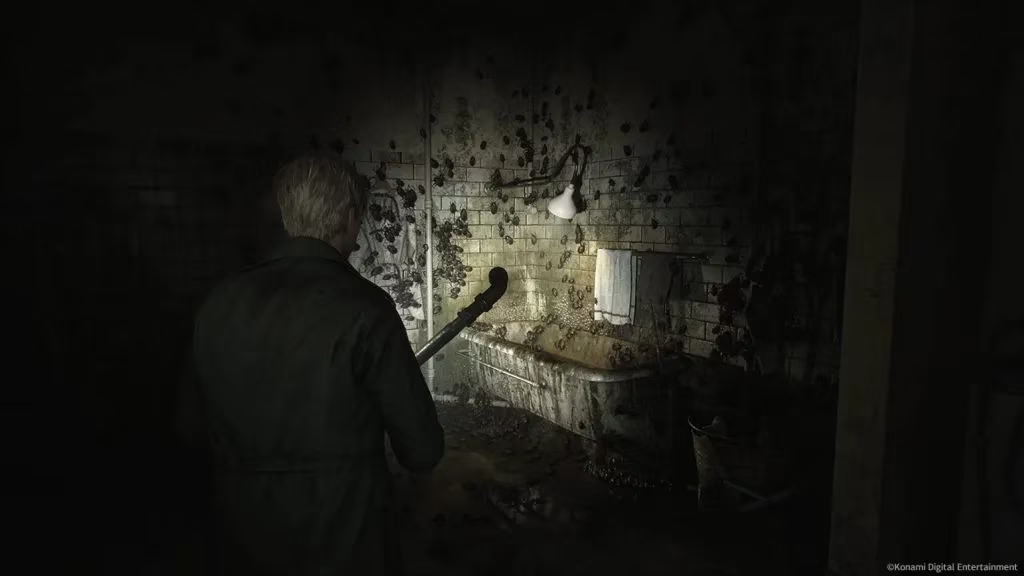
Before the remake launched, the doubt surrounding the project was almost suffocating. Could a studio known mostly for psychological horror walking simulators truly handle the weight of one of the most revered survival horror games in history? The positive reviews that flooded in upon release answered that question with a resounding yes. What Bloober Team managed to achieve is a masterclass in respectful modernization — every piece of the original’s soul has been preserved while the entire experience has been rebuilt from the ground up with cutting-edge technology.
A Masterful Translation of Dread
From the very first moments as James Sunderland arrives in the mist-veiled town, the atmosphere grabs you by the throat. The Unreal Engine 5-powered visuals wrap Silent Hill in a photorealistic shroud that makes the decay palpable. I could almost smell the damp concrete and rust in the dilapidated apartments. The fog is not just a visual effect — it is a living entity that contorts shapes and sounds, constantly making me question whether what I saw in the distance was a monster or merely my fraying nerves.
Yet the true miracle is that none of this graphical fidelity betrays the surreal, dreamlike quality of the PS2 original. The town still feels like a personal purgatory, twisted by James’s guilt and subconscious. The camera system, now a modern over-the-shoulder perspective seamlessly blended with occasional cinematic angles, makes exploration fluid without sacrificing the claustrophobia. I never once felt like the update had turned Silent Hill into an action shooter; every combat encounter remained a desperate, clumsy struggle for survival.
Sound and Silence Redefined
Audiowise, the remake is nothing short of a revelation. Akira Yamaoka’s iconic score has been reimagined with new layers of industrial scraping and melancholic piano, and the implementation of 3D spatial audio means that every radio static crackle now has a physical direction and distance. I played in a dark room with a good headset, and there were moments when I had to pause the game simply to catch my breath. The enemy designs — the twitching Lying Figures, the grotesque Abstract Daddies — are rendered with terrifying detail, their movements powered by motion capture that makes the uncanny more human and therefore more disturbing.
What impressed me most, however, was the cast. Bloober Team took a monumental risk recasting the original voices, but it paid off spectacularly. The new performances carry an emotional rawness that modern audience expect, yet they preserve the deliberate, almost stilted delivery that made the original dialogue so unsettlingly dreamlike. James’s quiet desperation, Maria’s ethereal melancholy, and even Eddie’s fragile rage feel authentic to the 2001 versions while standing firmly on their own.
Honoring a Legacy Without Betraying It
The story itself remains unchanged in all the ways that matter. The themes of grief, guilt, and self-inflicted punishment unspool with the same devastating power. Bloober did not try to \u201cfix\u201d what was never broken. Instead, they wove subtle environmental details — new notes, extended scenes that add context rather than alteration — that enrich the narrative for returning players without confusing newcomers. The multiple endings are all present, and unlocking them remains tied to obscure, esoteric behaviors that reward careful observation.
I have seen countless remakes stumble by changing too much or too little. Silent Hill 2 Remake operates on the same prestigious level that Capcom’s Resident Evil 2 Remake has occupied for years now — it is the definitive way to experience a masterpiece. Every dark corridor, every mirror reflection, every whisper on the radio builds toward a climax that left me emotionally wrecked in the best possible way. Even in 2026, with AI-driven open worlds and hyper-realistic simulations becoming the norm, this game stands as proof that focused, authorial vision and respect for source material can create something that feels timeless. If you call yourself a fan of horror or narrative-driven games and have not yet stepped into the fog, consider this my personal plea: you owe it to yourself to play this perfect 10/10.
Quick Glance: Why It’s a 10/10
| Aspect | What Makes It Exceptional |
|---|---|
| Atmosphere | Unreal Engine 5 fog and lighting create a suffocating dread |
| Gameplay | Over-the-shoulder camera with authentically clumsy combat |
| Audio | Reimagined Yamaoka score with positional 3D audio |
| Voice Acting | New cast delivers raw, dreamlike performances |
| Narrative | Unchanged core story with subtle, meaningful additions |
| Fidelity | Respects the original\u2019s soul while modernizing everything |
So yes, finding a true 10/10 experience in gaming is like catching lightning in a bottle. Silent Hill 2 Remake pulls it off with a confidence that feels almost otherworldly. I played it, I wept through its ending once more, and I immediately started a new playthrough. Enough said.
Industry analysis is available through Game Developer (Gamasutra), and it’s a useful lens for understanding why a project like Silent Hill 2 Remake can modernize combat, camera, and audiovisual tech without diluting the original’s psychological horror cadence—because the hardest part of remaking a classic isn’t fidelity to assets, it’s fidelity to pacing, player vulnerability, and the emotional intent behind every encounter.