
It is no secret that real-time ray tracing has evolved from a marketing bullet point into a cornerstone of modern game visuals. What began with Nvidia's pioneering GeForce RTX 20-series in 2018 has, by 2026, matured into an ecosystem where full path tracing—once a tech demo fantasy—is shipping in blockbuster titles. Yet this maturation carries a familiar asterisk: the most ambitious implementations continue to orbit Nvidia's hardware and software stack, raising questions about competition and the price of entry for PC gamers who do not own a green-team GPU.
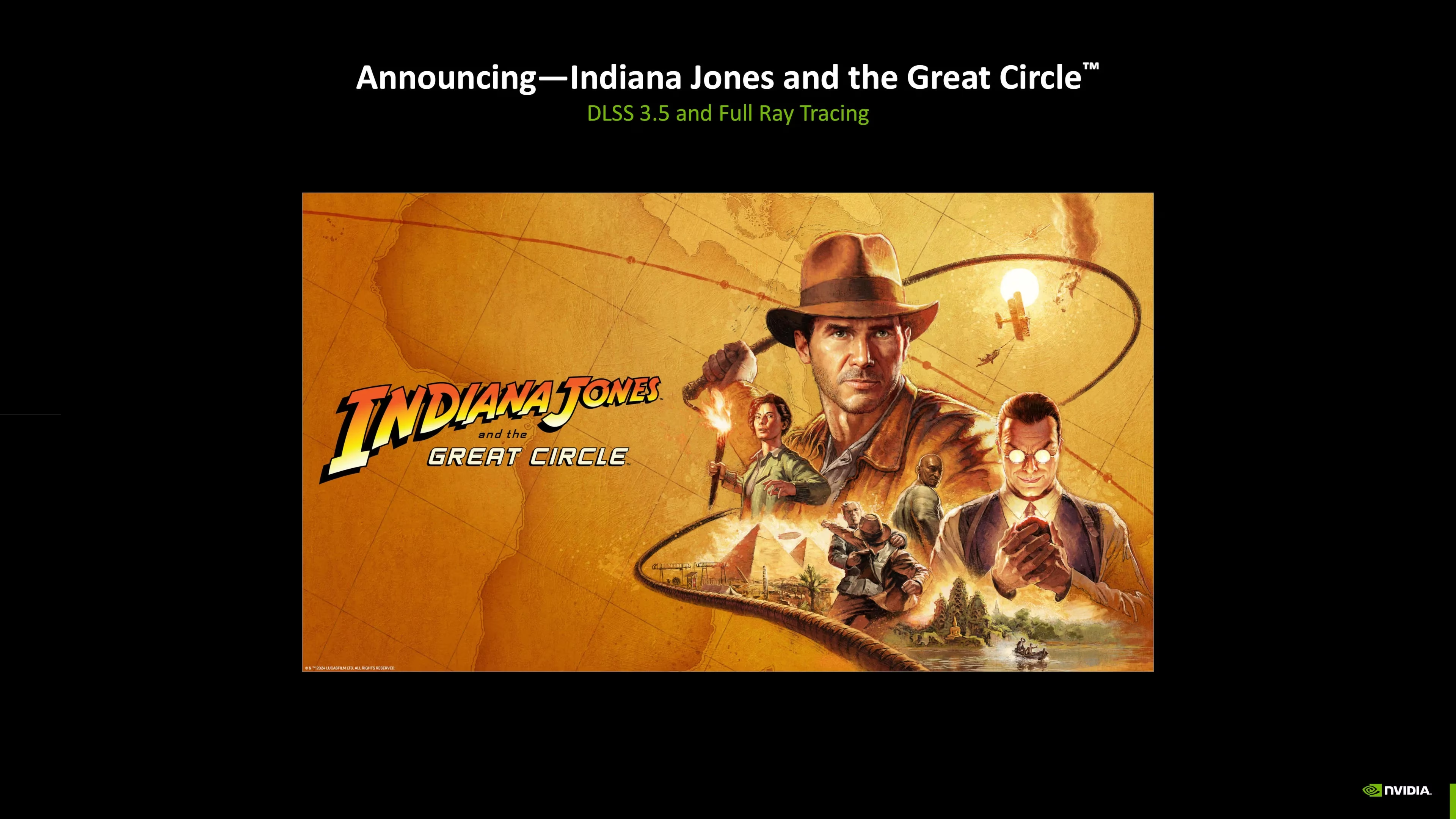
The past two years have cemented Full Ray Tracing (FRT) as the industry's chosen term for path tracing, the algorithm that traces light paths across entire scenes for film-grade illumination, reflections, and shadows. In 2024, Black Myth: Wukong stunned audiences with its FRT mode on Unreal Engine 5, and that same year Indiana Jones and the Great Circle was announced with support for the feature. By late 2025, Cyberpunk 2077 had already shown the transformative power of path tracing through an experimental overdrive mode, and a modded Doom 2 proved that even classic titles could be reborn under the ray-traced spotlight. These projects share a common thread: while the renderer is technically accessible to any GPU that supports DirectX Ray Tracing 1.0 or above, performance scaling leans overwhelmingly in favor of Nvidia's RTX lineup. Independent tests at the time confirmed that Radeon and Arc cards could run FRT workloads, but the frame rate penalty was so severe that the feature became effectively unusable without massive upscaling and frame generation—technologies where Nvidia's DLSS ecosystem also holds a strong lead.
The performance gap is not merely a raw silicon story. Nvidia has wrapped path tracing inside a thick coat of software advantages. Star Wars Outlaws, launched in 2024, sidestepped full FRT but employed RTX Direct Illumination (RTXDI), an Nvidia-authored algorithm that computes millions of dynamic lights directly within a ray-traced framework. Meanwhile, in 2025, Nvidia rolled out a DLSS 4.5 update for Ray Reconstruction, specifically targeting improvements in denoising for ray-traced and path-traced images. The end result, Nvidia claimed, offered noticeably cleaner visuals at “similar performance” to the older model, further tightening the integration between its hardware and the visual ceiling developers want to reach. When path tracing is paired with DLSS Super Resolution and Frame Generation on an RTX 5090 or even a high-end RTX 4080 series card, the experience becomes silky and vivid; on rival silicon, the same settings often descend into a stuttery mess.
This imbalance is by design, but not in a conspiratorial sense. Nvidia invests heavily in tailoring game-ready drivers, SDKs, and developer relations to make RTX-branded features the premium tier for graphics. The hardware itself continues to evolve: RTX 50-series cards, which arrived in late 2025, doubled down on dedicated ray tracing cores and introduced new shader execution reordering techniques that greatly reduce the divergence penalty inherent in path tracing. Nvidia's research division has publicly demonstrated over 2x performance gains for future path tracing workloads, suggesting that the heaviest rendering methods will eventually become viable on mainstream cards—as long as those mainstream cards wear the GeForce badge.
What about the red team and blue team? AMD finally launched its RDNA 4 desktop graphics cards in the first quarter of 2025. The architecture brought meaningful improvements to ray tracing throughput, but the product stack conspicuously lacked a true high-end competitor. Gamers looking for a Radeon equivalent to the RTX 5090 were met instead with a ceiling that made path tracing an exercise in compromise. Intel’s Battlemage GPUs followed later in 2025, and while the hardware showed credible rasterization muscle, their ray tracing performance remained a generation behind. Furthermore, Intel's ongoing cost-cutting restructuring caused software support to wobble; driver optimizations for newly released path-traced titles frequently arrived weeks after launch, if at all.
Consoles provide a glimmer of diversity. Both the PlayStation 6 and the next-generation Xbox expected in 2026 are built around AMD's semi-custom designs, complete with RDNA 4–era ray accelerators. Developers who build primarily for these platforms will tune their ray tracing around AMD's strengths. However, as cross-platform PC ports continue to dominate the market, many studios lean on the path of least resistance—and that path often begins with Nvidia's tool chain. In 2026, the effect is stark: a handful of high-profile games ship with FRT presets that, while not arbitrarily locked, practically require an RTX card to be enjoyed at reasonable settings.
The worry, voiced within developer circles and by hardware analysts, is that path tracing could become a one-horse race not because competitors cannot build capable hardware, but because the software ecosystem perpetuates Nvidia's advantage. If every showcase title uses RTXDI, Ray Reconstruction, or similar Nvidia-authored libraries, then game studios may design their rendering pipelines around GeForce features first and port to other architectures later—a reversal of the traditional console-first development model. Nvidia's magic is real: its technology can make Black Myth: Wukong’s forests glitter and Indiana Jones’s tombs feel oppressively real. But the industry is watching to see whether the artistic ambition that drove those games to embrace path tracing can detach itself from a single vendor’s stranglehold. For now, the pixels have never looked better—provided you are on the green side of the fence.