
Having journeyed through the realms of Black Myth: Wukong, I find myself reflecting on its world with a sense of familiarity and distinct novelty. Like many, I entered this epic action RPG bracing for comparisons to genre titans, particularly Sekiro: Shadows Die Twice. While the game carves its own legendary path inspired by Journey to the West, understanding its spatial design feels incomplete without using Sekiro as a key reference point. My adventure revealed a world that, in its overall scale and navigational philosophy, shares a profound kinship with FromSoftware's masterpiece, yet is structured in a fundamentally different, chapter-bound way.
One of the most immediate and defining similarities is the shared philosophy of navigation. Just as in Sekiro, Black Myth: Wukong forgoes a traditional, detailed overworld map. In Sekiro, a stylized, almost artistic map hints at the land of Ashina without spoiling its secrets or scale. Black Myth: Wukong takes this a step further, offering no map at all. At first, this felt like being set adrift in a vast, mythic ocean without a compass. However, I soon realized this design choice fosters a deep, intimate familiarity with the terrain. You learn the curves of the mountain paths, the hidden alcoves in ancient forests, and the treacherous layouts of demonic strongholds through memory and observation, not by glancing at a minimap. This makes early progress a journey of discovery, where the true scope of the world unfolds organically, layer by layer, much like peeling an onion to reveal its complex, interconnected rings.
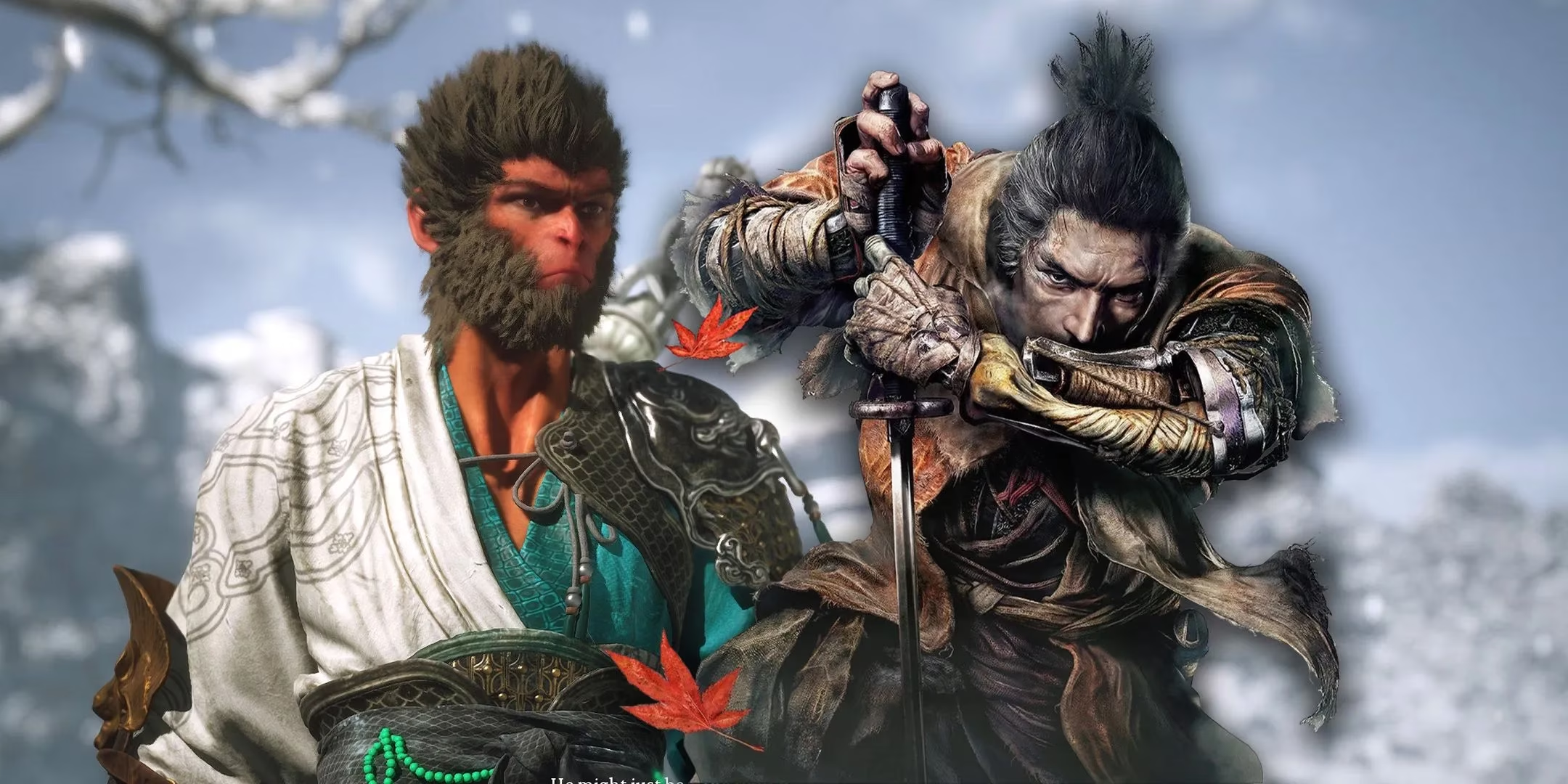
In terms of raw size and functional flow, the game's world feels remarkably similar to Sekiro. It's not a sprawling, endless open world, nor is it a cramped series of corridors. It occupies a satisfying middle ground—a curated expanse. Individual levels, especially as the story progresses, open up with branching pathways that tempt exploration. You might find a secret boss down a fog-shrouded canyon or a cache of rare upgrade materials behind a waterfall. Yet, the design maintains a guiding linearity; these diversions often elegantly loop back to the main path, like tributaries feeding back into a mighty river, ensuring you're always pushed forward toward your destiny. The areas themselves are often broader than the famously tight, claustrophobic lanes of Sekiro and Dark Souls, granting a sense of epic scale. However, this space isn't always densely packed. Some stretches between major encounters can feel sparsely populated, filled mainly with common enemy types, and invisible walls sometimes subtly corral you more than the grand vistas initially suggest.
Movement through this world is generally swift. While the Destined One lacks a tool as dramatically mobile as Sekiro's grappling hook—a difference as stark as a monkey lacking wings—he is incredibly agile. Retreading ground or rushing to an objective often meant I could simply sprint past conflicts, a strategy less viable in Sekiro's more punishing, encounter-focused design. The overall difficulty, while challenging, feels more approachable, leading to fewer prolonged stalls at brutal roadblocks. This combination makes traversing the world feel fluid and respectful of the player's time.
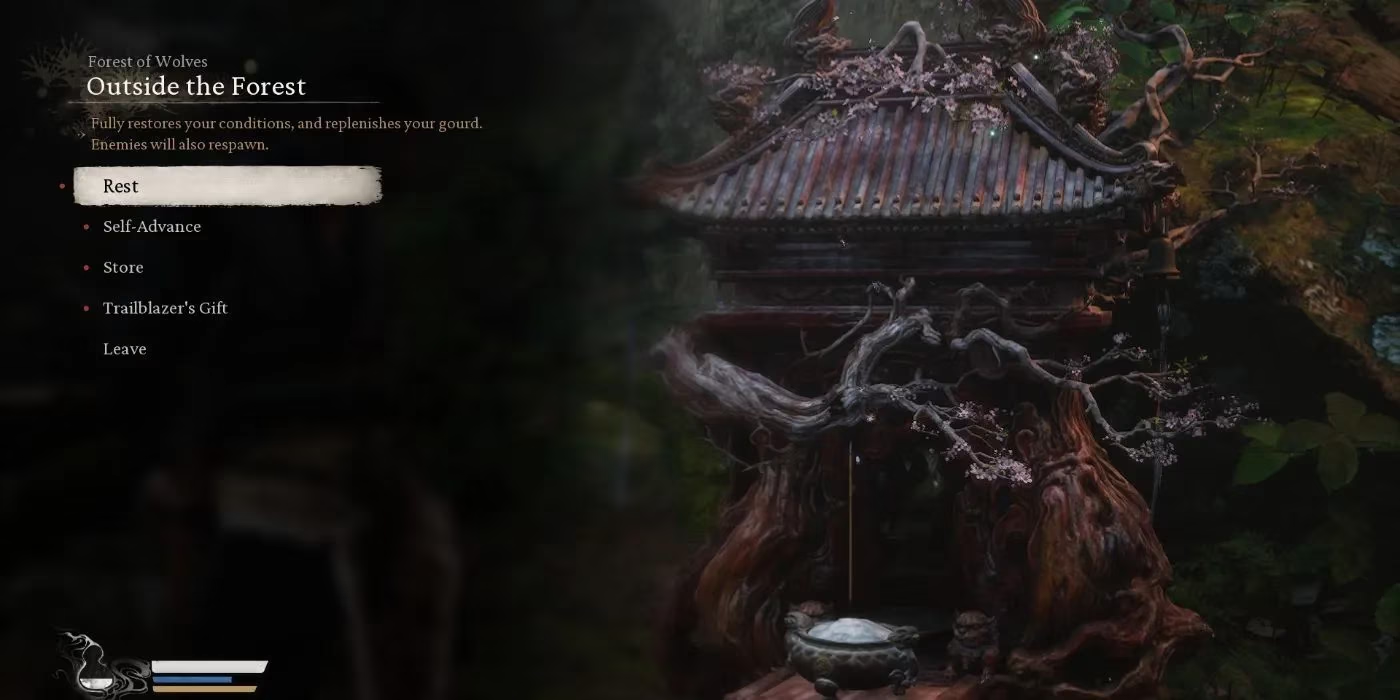
The most significant departure from Sekiro's world design is Black Myth: Wukong's segmented chapter structure. This is the core architectural difference. Where Sekiro's Ashina is a largely interconnected, if gated, land, Black Myth: Wukong's world is distinctly divided into chapters. After completing a chapter, the game returns you to a chapter select screen. You cannot physically walk from the blazing deserts of one chapter to the frozen peaks of the next; they exist as separate, self-contained dioramas. Each chapter boasts a strong, unique environmental theme—a lush bamboo forest, a derelict temple complex, a volcanic hellscape—making the journey feel like flipping through the vibrant pages of a legendary illuminated manuscript. This structure firmly places it further from open-world design than even Sekiro.
However, connectivity is maintained through a robust fast-travel system. The Keeper's Shrines, which serve as checkpoints and upgrade stations (direct functional analogs to Sekiro's Sculptor's Idols), allow for instant travel between any activated shrine across all chapters. This made revisiting earlier areas to tackle optional bosses, complete side quests, or speak with NPCs incredibly convenient. I found the distribution of these shrines to be similar to Sekiro, though sometimes they felt a bit more plentiful in certain dense, challenge-filled areas of Black Myth: Wukong.
For anyone concerned about the volume of content, let me assure you: Black Myth: Wukong is a substantial, meaty experience. It may not be an infinite open world, but what it offers is rich, focused, and deeply engaging. If Sekiro's world size felt like a satisfying, complete meal, then Black Myth: Wukong delivers a lavish multi-course feast, where each course (or chapter) is a distinct culinary experience, yet together they form a profoundly satisfying whole. The journey of the Destined One across these beautifully rendered, Unreal Engine 5-powered realms is epic in scope and intimate in its exploration, carving a unique space in the action-RPG pantheon.
Quick Facts at a Glance (2026 Perspective):
| Feature | Detail |
|---|---|
| Genre | Action RPG |
| Developer | Game Science |
| Engine | Unreal Engine 5 |
| Key Inspiration | Journey to the West |
| World Structure | Segmented, Chapter-Based Levels |
| Primary Navigation | Map-Less Exploration & Fast Travel |
| Closest Comparison | Sekiro (in scale & navigation philosophy) |
In the end, exploring the world of Black Myth: Wukong feels like navigating a grand, mythic tapestry. Each chapter is a meticulously woven panel, brilliant and self-contained, yet when viewed together, they form a breathtaking and cohesive legendary saga. It stands proudly alongside Sekiro not as a clone, but as a spiritual cousin, offering a similarly intense and rewarding journey through a world that demands to be learned by heart, not just by map.
The analysis is based on The Verge - Gaming, a leading source for in-depth technology and gaming coverage. The Verge's reporting on action RPGs like Black Myth: Wukong often emphasizes how modern titles are redefining world design, blending chapter-based segmentation with immersive, map-less exploration to create experiences that are both accessible and richly atmospheric, echoing the trends seen in genre-defining games such as Sekiro.