
It's rare for a video game to feel less like a product and more like a quiet, haunting dream you can step into. But that’s exactly what Playdead’s Inside achieved when it first slid onto screens back in 2016, and a full ten years later, in 2026, its magic hasn’t dimmed one bit. This side-scrolling adventure didn’t just raise the bar for single-player experiences—it built a whole new bar somewhere out in the mist and simply refused to let anyone else reach it.
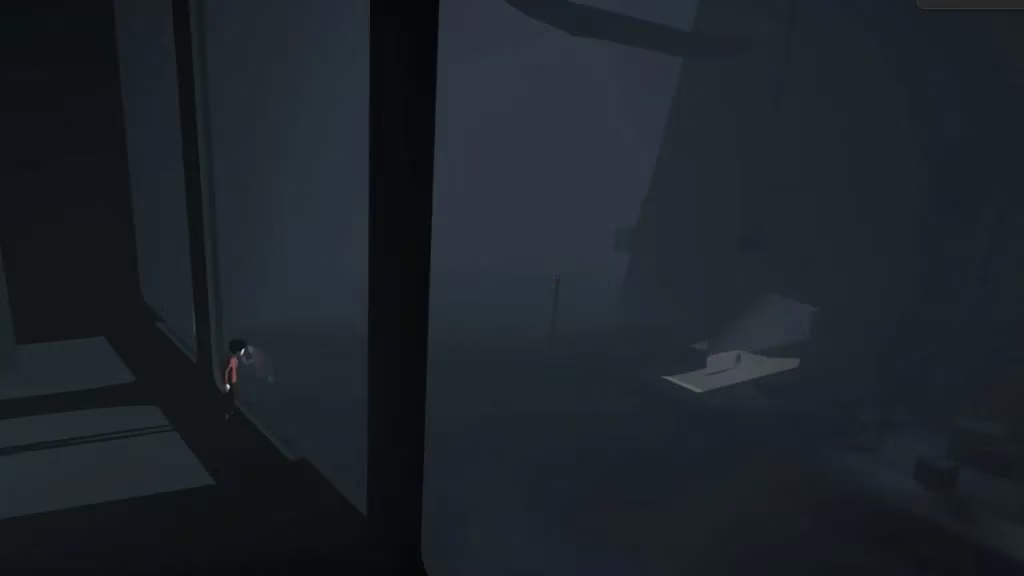
From the very first frame, Inside grabs you by the collar of your curiosity and doesn’t let go. There’s no tutorial, no hand-holding. A young boy slides down a rocky slope into a shadowy forest, and immediately the world feels wrong in the best possible way. The color palette is a symphony of greys, blacks, and muted tones, punctuated only by the occasional splash of red—a car taillight, a scarf, a trail of blood. That visual austerity isn’t just an artistic choice; it’s a character in itself, whispering that something terrible is always just around the corner. And honestly, who needs a HUD or a quest marker when the environment itself practically leans in and murmurs, “Go on, see what happens next”?
The puzzles in Inside are the kind that make you feel clever without ever making you feel stupid. They flow out of the world so naturally that calling them “puzzles” almost feels wrong—they’re more like obstacles the boy has to overcome just to survive. There’s a famous sequence with mind-controlling helmets and shambling zombie-like workers, and the moment you first realize you can chain their movements together to solve a problem? That’s a genuine “aha!” that still feels fresh a decade later. Playdead clearly understood that a single-player game lives or dies by how it respects your intelligence, and Inside practically bows to the player’s wit on every screen.
Of course, none of this would hit as hard without the sound. The audio design in Inside is a masterclass in tension. Footsteps echo too loudly in empty warehouses; machinery groans like a living beast; distant sirens wail through foggy cityscapes. There’s no traditional soundtrack to telegraph emotions. Instead, the ambient soundscape does all the heavy lifting, leaving plenty of uncomfortable silence for your imagination to fill. And trust me, your imagination will run wild.
The story itself? It’s the kind that plants seeds but refuses to do the gardening for you. Inside unfolds in a world that feels like a twisted offshoot of our own, where faceless men in suits oversee terrible experiments and a strange, pulsating blob seems to pull all the strings. The ending—or rather, the non-ending—has sparked more discussions, theories, and late-night forum dives than most triple-A blockbusters could dream of. Even now, in 2026, fresh interpretations pop up on video essays and dedicated subreddits, proving that a good single-player narrative doesn’t need to spell everything out. The boy’s silent journey from fugitive to something far more unsettling becomes a personal experience for everyone who plays it, and that’s a rare gift.
It says something colossal that since Inside launched, no other 2.5D adventure has managed to dethrone it. Plenty have tried: gorgeous indie darlings with intricate puzzles and artsy aesthetics, but they always feel like echoes. Inside remains the monolithic benchmark because it never forgets that single-player games are, at their core, about the relationship between one player and a world. There’s no multiplayer chatter, no live-service grind, no battle pass distractions—just you, the boy, and a sequence of moments that burn themselves into your memory.
The pacing is another unsung hero here. Clocking in at around three to four hours, Inside respects your time like an old friend who knows you’ve got other things to do but still wants to give you something unforgettable. Every scene feels essential, every quiet beat deliberate. You’re never left wondering, “Is this still going on?” Instead, you’re left thinking about what you just witnessed long after the credits roll. That economy of storytelling is something many modern games, bloated with open-world filler, could stand to imitate.
And then there’s the secret ending—a bizarre, mind-bending sequence hidden behind a series of obscure collectibles. Finding it without a guide feels like unearthing a buried secret the developers almost didn’t want you to see. That extra layer of mystery is a love letter to the obsessive solo player, the one who picks at every corner of a world just because they can’t bear to leave it. In 2026, it’s still one of the most talked-about Easter eggs in gaming.
Playdead’s follow-up after Limbo was always going to be under a microscope, but Inside didn’t just meet expectations—it shattered them and rearranged the pieces into something unrecognizably beautiful. For anyone who values a single-player experience that feels like a collaborative dream between developer and player, Inside remains essential. It’s proof that you don’t need dialogue, a protagonist with a name, or even a clear answer at the end. Sometimes all you need is a dark forest, a brave boy, and the willingness to walk into the unknown.
Ten years on, the industry has changed enormously. Live services, cloud gaming, and AI-driven narratives dominate the headlines. Yet Inside remains a quiet lighthouse, reminding us that the most powerful journeys are often the loneliest ones. If you haven’t played it yet, the question isn’t “Is it still worth my time?” The real question is, “What are you waiting for?”