
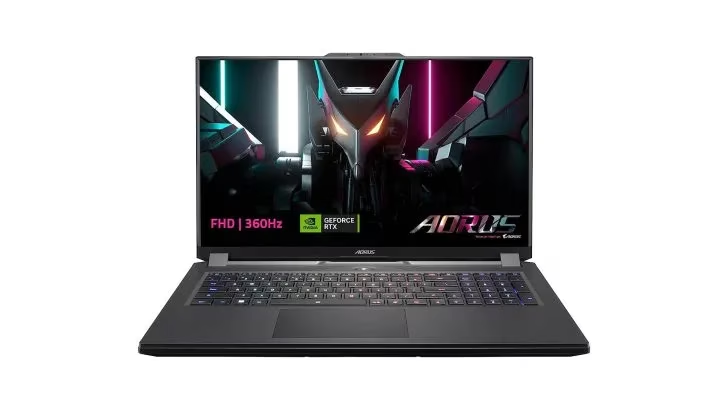
In 2026, Black Myth: Wukong has settled into its role as a familiar benchmark heavyweight, yet the lesson it taught laptop shoppers two years earlier still lands with force. The action RPG does not politely ask for headroom; it grabs the nearest GPU by the collar and demands a serious answer. At the highest 'Cinematic' preset, without upscaling, it can bring the most powerful graphics chips to their knees. The GIGABYTE AORUS 17H, fitted with an RTX 4080, answers anyway. With DLSS and Frame Generation switched on, the 17.3-inch machine handles the title rather than merely surviving it. Both features belong to the RTX 4000 series family, and together they give the laptop a calm, almost smug confidence. To say the game is intensive would be a massive understatement. 😅
A 2026 Look at a 2024 Value Play
The AORUS 17H was never just a pretty shell. Under the hood sits a 14-core Intel Core i7-13700H, paired with 16GB of DDR5 RAM and a 1TB PCIe NVMe Gen 4 SSD. That combination produces unrivaled gaming-laptop performance and ultra-responsiveness in the context of its class. The 17.3-inch portable powerhouse is built for players who want desktop-class ambition without a desktop-sized anchor.
A 2024 promotion cut $400 from the price, bringing the AORUS 17H down to $1,799. At the time, every other RTX 4080-powered machine on the same major retail listing crossed the $2,200 threshold. By 2026, newer generations have arrived and the market has shifted, but the episode remains a useful reminder: a well-cooled RTX 4080 laptop with a strong CPU can stay relevant long after the launch window closes. The futureproofing argument has aged into evidence.
| Component | Configuration | Why it mattered |
|---|---|---|
| GPU | NVIDIA GeForce RTX 4080 Laptop GPU | DLSS and Frame Generation make demanding titles playable at high presets |
| CPU | 14-core Intel Core i7-13700H | Keeps frame pacing and everyday tasks responsive |
| Memory | 16GB DDR5 | Enough for gaming and multitasking, though heavier workflows may want more |
| Storage | 1TB PCIe NVMe Gen 4 SSD | Fast loads and room for a sizable library |
| Display | 17.3-inch 1080p, up to 360Hz | Excellent for esports, less ideal for high-fidelity sightseeing |
| 2024 promo price | $1,799 after a $400 discount | Undercut most RTX 4080 laptops by a wide margin |
The Display Keeps One Foot in Esports
The AORUS 17H has a 1080p panel, and that is about the only gripe worth repeating. The display refreshes at up to 360Hz, which makes it a natural fit for esports titles where motion clarity matters more than pixel density. Still, with an RTX 4080 inside, the hardware quietly begs for a 1440p panel. It is a strange little mismatch: the GPU rolls up its sleeves for fine detail, while the screen stays firmly in speed-demon territory.
There are two practical remedies. A buyer can pair the laptop with a QHD high-refresh gaming monitor, turning it into a compact desktop replacement. Or a buyer can spend a little more cash and step up to the GIGABYTE AORUS 17X at $2,199 after a $300 discount. That model carries a 2560 x 1440 resolution panel with a 240Hz refresh rate. In 2026, QHD monitors are common and often affordable, so the AORUS 17H can still sit at the center of a very capable setup.
The Verdict That Survives the Years
For pure value, the GIGABYTE AORUS 17H remains the more compelling story. It offers incredible value for the money, especially for players who care more about frame rates than pixel counts. The RTX 4080 gives it room to breathe in demanding games, and DLSS plus Frame Generation extend its useful life. Black Myth: Wukong was a warning shot; the years since have brought more mega-intensive releases, and the laptop has kept its composure. That is not bad for a machine whose biggest flaw is a screen that simply picked the wrong specialty. 🎮