
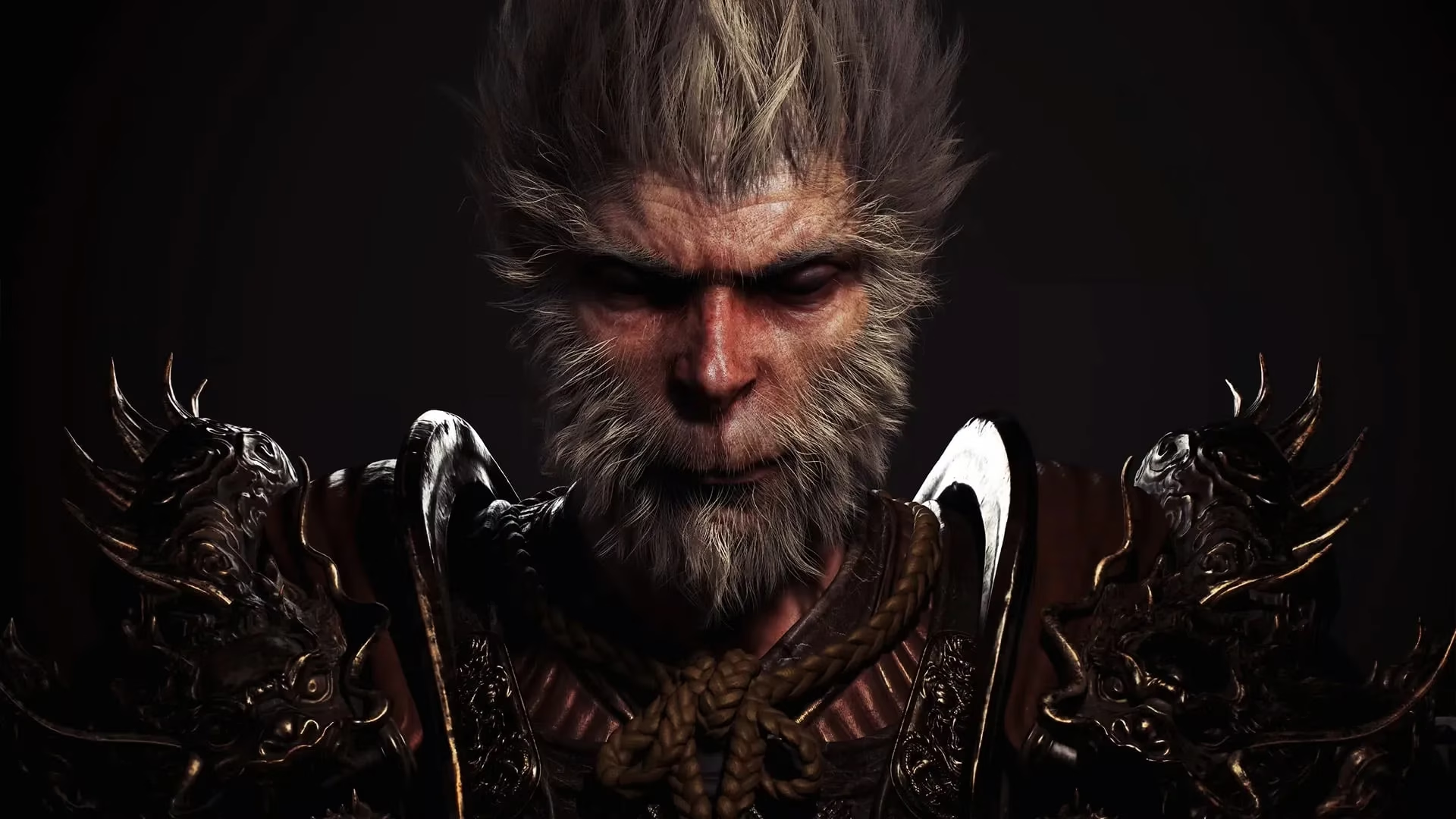
I still remember the collective groan that echoed through every Xbox forum back in August 2024. We had just witnessed the absolute domination of Black Myth: Wukong on PC and PlayStation 5—10 million copies sold in a few short weeks, PS5 consoles flying off shelves in China—but us Xbox players? We were stuck refreshing our news feeds, waiting for a release date that never came. Honestly? I was fuming. The wait, as it turned out, wasn’t just a simple marketing exclusivity window. No, something much messier was lurking in the code.
Whispers started at Gamescom 2024. The well-known Xbox insider eXtas1s dropped a bombshell: Game Science’s masterpiece had reportedly failed Xbox’s bug detection tests. Not once, but twice. The culprit? A sneaky, infuriating technical gremlin called a memory leak. Let me break that down for you in plain gamer terms. A memory leak is basically the game refusing to clean up after itself—allocating RAM to load a majestic boss arena, then after you move on, that chunk of memory doesn’t get freed. Over time, the poor console just suffocates under its own weight, leading to stutters, freezes, and eventually a full-blown crash. On a machine with a unified memory architecture like the Xbox Series X|S, it’s a death sentence for stability. And according to those early reports, the crashes were significant.
That news hit like a charged heavy attack. eXtas1s had spoken directly with developers and Xbox insiders, and the message was clear: the game had been “indefinitely delayed until they manage to optimize the game for Series X|S.” I could almost hear the collective sigh from the community. We had this beautiful reimagining of Journey to the West, a visual feast that pushed Unreal Engine 5 to its limits, and yet a tiny, persistent memory bug was holding it back. You know what’s funny? A game about a shape-shifting immortal monkey couldn’t wriggle its way past a certification test. The irony wasn’t lost on anyone.
The Twice-Failed Certification
Getting a game onto Xbox isn’t just about pressing a “publish” button. Microsoft has rigorous technical requirements. If your title can’t run for a set amount of time without crashing, or if it shows severe performance degradation, it won’t pass. Black Myth: Wukong failed that test twice. Think about the pressure on the dev team at Game Science. You’ve just become a global phenomenon, your art direction is being praised everywhere, and suddenly the entire Xbox ecosystem is locked out because of a low-level memory management flaw. It must have been brutal. The narrative around the delay started to morph, too. Some folks speculated it was a platform deal with Sony, but the memory leak story perfectly explained the “indefinite” timeline. It wasn’t a month-long exclusivity; it was a deep engineering problem.
So what were Game Science working on? They had to go back into the code’s plumbing. Memory leaks in Unreal Engine can be nasty. Often they stem from how assets are loaded and destroyed, or from objects that hold references to resources long after they’re needed. For a game as dense as Black Myth: Wukong—with its sprawling environments, particle-heavy spells, and creatures that can jump you from off-screen—optimizing that for the Xbox’s dual-tier hardware (Series X and the weaker Series S) was a monumental task. The Series S, bless its little heart, has less accessible memory bandwidth, which makes these leaks even more catastrophic. I imagine programmers burning the midnight oil, staring at debug readouts, muttering “why won’t this monkey just let go of the cached texture?” It was, in every sense, a boss fight of its own.
2026: The Light at the End of the Tunnel
Fast forward to today, 2026. After nearly two years of radio silence broken only by cryptic patches and developer notes, the fix finally arrived. In late 2025, a massive performance update silently rolled onto the PC version, and dataminers found traces of Xbox-specific optimizability flags. Then, a month ago, Game Science dropped the tweet we’d all been waiting for: “Xbox Series X|S launch imminent.” No “indefinite” talk anymore. The game had passed certification. I downloaded it on day one, bracing for the worst, but… it was smooth. Perfectly smooth. Well, guess what? Here we are in 2026, and the long nightmare is over.
The lesson here? A memory leak once managed to delay one of the biggest action RPGs of the decade. It’s a stark reminder that no matter how beautiful a game looks, the real boss battle is always the engineering. I’d love to know—were any of you waiting out the storm like I was? Or did you cave and grab a PS5 back then? Drop your story in the comments, and let’s finally celebrate that Xbox players can step into the Destined One’s shoes.