
In the ever-evolving tapestry of the gaming cosmos, a legend born from ancient folklore has carved its own modern saga. The tale of Black Myth: Wukong is one of meteoric ascent, a narrative not just of a game's success, but of a pilgrimage across platforms. Having ignited the imaginations of millions on PC and PlayStation 5 in 2024, the celestial warrior's journey felt, for a time, curiously incomplete—a grand opera missing its final, resonant movement on the stage of Microsoft's consoles. The wait, a period of hushed anticipation among a devoted fellowship of players, was a silence filled with the echoes of its prior triumphs: over ten million souls claimed in its first week, a titan of the year standing shoulder-to-shoulder with legends for the highest honors. Now, in the dawn of 2026, that silence is shattered. The pilgrimage reaches its long-awaited destination. Game Science, the studio that conjured this myth into being, has decreed that on August 20, 2025, the gates to the Xbox Series X and S realms finally swung open, welcoming a new legion to walk the path of the Great Sage Equal to Heaven.
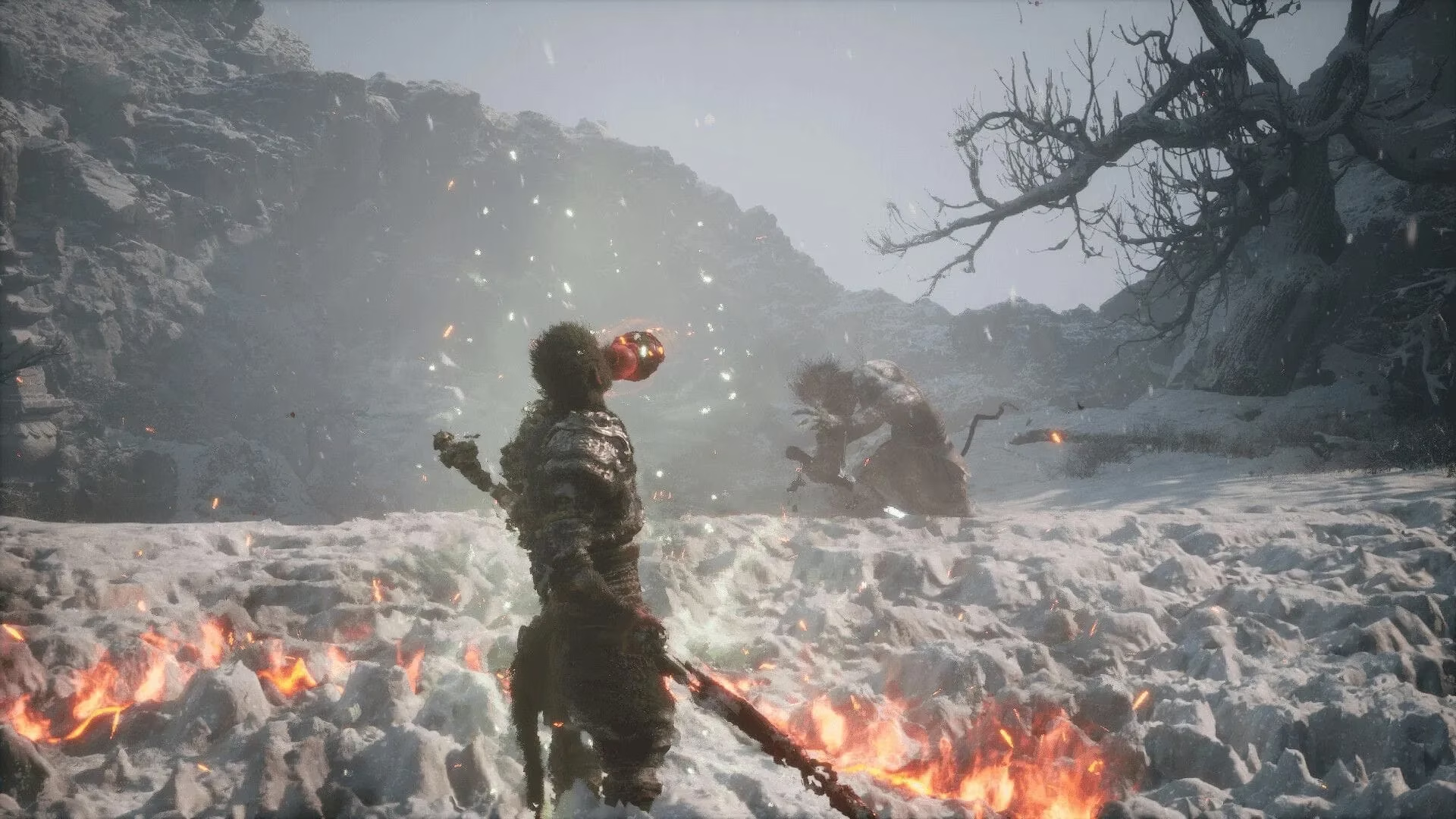
The delay of the Xbox version was a curious chapter in this epic. Initially promised as a simultaneous release with its sibling platforms, technical tribulations—like invisible barriers woven from unstable code—forced a strategic retreat. For Xbox disciples, the game's absence was a phantom limb, a sensation of something magnificent happening just beyond a translucent veil. Yet, this interlude was not a defeat but a refinement, a period where the developers, like master jade carvers, smoothed away imperfections to ensure the experience on Microsoft's hardware would be as flawless as a moonlit pearl. The announcement of the August 2025 release date was not merely a schedule update; it was the lowering of a drawbridge, an invitation extended with the solemnity of a royal decree.
The arrival was heralded with the fanfare of pre-orders, commencing on June 18, 2025. For the eager, this was the chance to secure their ticket to the journey before the gates were officially unsealed. The studio, in a gesture of goodwill, offered a digital discount—a golden invitation to embark at a gentler toll. This period of anticipation was a slow-burning fuse leading to the grand explosion of release day, timed with celestial precision to align with the stroke of midnight in Beijing, a nod to the tale's profound roots.
The Legacy of a Modern Myth
Reflecting from 2026, the impact of Black Myth: Wukong is undeniable. Its success was a seismic event in the industry landscape, proving that profound, culturally-rich narratives could command global audiences. For a relatively nascent studio like Game Science, its achievement was akin to a sapling growing into a world-tree overnight, its branches heavy with the fruit of critical and commercial acclaim. The game was more than an action-RPG; it was a meticulously crafted portal, a cinnabar-painted doorway into a world where every rustle of bamboo and clash of staff against armor felt pulled from the pages of a living, breathing legend.
The combat, a ballet of mystical arts and transformative prowess, demanded precision and patience. Players did not merely fight; they engaged in a rhythmic dialogue with ancient demons and celestial guardians. Each victory was hard-won, each defeat a lesson etched in memory. The world itself was a character—a realm where mist-clad mountains held secrets and dilapidated temples whispered forgotten prayers. Exploring it felt like tracing the intricate patterns on a timeworn silk tapestry, where every thread revealed a fragment of a larger, majestic story.
The Xbox Ascent: A New Chapter
The Xbox release completed the trilogy of platforms, a triumvirate now whole. For Series X and S owners, it was the end of an exile. They could finally don the mantle of the Monkey King, wielding the transformative Ruyi Jingu Bang against the host of Heaven and the denizens of the underworld. The technical performance on the consoles was a testament to the extra development time, offering a experience as smooth as ink flowing from a master's brush. While the question of its inclusion in the Xbox Game Pass library remains a scroll yet unfurled, the mere availability of the standard edition was a cause for celebration.
The game's enduring appeal lies in its masterful blend of the familiar and the novel. It takes the timeless Journey to the West and refracts it through a dark, mature lens, creating an experience that is both homage and innovation. The sound design alone is a character—the mournful wind through gorges, the otherworldly chants of distant monks, the thunderous impact of magical strikes. It is an auditory landscape as deep and complex as its visual one.
In conclusion, the saga of Black Myth: Wukong is a testament to artistic vision and player faith. Its journey to the Xbox was the final leg of an odyssey, transforming it from a platform-exclusive phenomenon into a universal legend. It stands in 2026 not just as a game of the past, but as a benchmark—a celestial compass pointing toward the future of story-driven, culturally authentic blockbusters. For those who embarked on the adventure with its Xbox dawn, they did not just play a game; they added their own verse to an ancient, ongoing song.